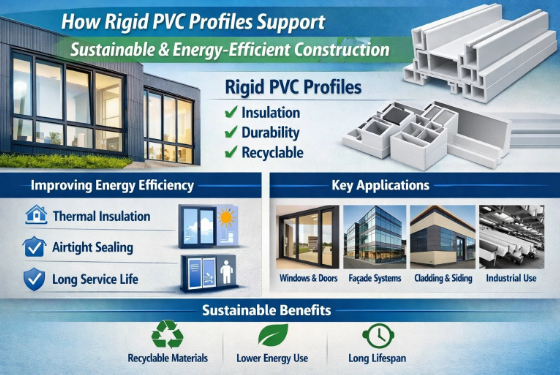
In modern construction, materials are no longer chosen only for strength or cost. Builders and engineers now look for options that reduce energy loss, improve durability, and support long-term environmental goals. In many projects, rigid PVC profiles solutions are becoming a practical choice because they balance performance, efficiency, and consistency in real construction conditions.
From window systems to façade structures, rigid PVC profiles are used where stability and energy performance matter most. Their role is not theoretical. It is visible on building sites, in manufacturing plants, and in long-term building performance.
What Are Rigid PVC Profiles?
Rigid PVC profiles are extruded plastic components made from polyvinyl chloride with a solid, non-flexible structure. They are designed for structural and functional use in construction systems such as windows, doors, façades, and cladding.
Unlike flexible plastics, rigid PVC maintains shape under load and temperature changes. This makes it suitable for applications where precision and durability are required.
In simple terms, rigid PVC profiles act as building elements that support structure, insulation, and system integration.
Why Sustainability Matters in Construction Materials
Buildings consume a large share of global energy, mainly through heating, cooling, and lighting. Material choices directly affect how much energy a building uses over its lifetime.
Common sustainability challenges in construction include:
- Heat loss through windows and façades
- High maintenance requirements
- Short material lifespan
- Poor insulation performance
- Difficulty in recycling materials
Rigid PVC profiles address many of these challenges through their physical and thermal properties.
How Rigid PVC Profiles Improve Energy Efficiency
1) Thermal insulation performance
Rigid PVC has low thermal conductivity compared to metals such as aluminium or steel. When used in window and façade systems, it reduces heat transfer between indoor and outdoor environments.
Energy-efficient PVC profiles help:
- Reduce heating and cooling loads
- Maintain stable indoor temperatures
- Improve overall building energy ratings
In practical terms, this means lower energy consumption and more consistent indoor comfort.
2) Airtightness and system integration
Energy loss often happens through gaps in building envelopes. Rigid PVC profiles are manufactured with precise dimensions, which improves sealing in window and façade assemblies.
Benefits include:
- Better joint alignment
- Reduced air leakage
- Improved performance of sealing systems
When combined with proper installation, rigid PVC profiles contribute to airtight building designs.
3) Durability and long service life
Sustainable construction is not only about initial materials but also about how long they last. Rigid PVC profiles are resistant to moisture, corrosion, and many environmental factors.
This leads to:
- Longer replacement cycles
- Lower maintenance needs
- Reduced material waste over time
From a lifecycle perspective, durable materials support sustainable building practices.
Role of Sustainable PVC Materials in Construction
Sustainable PVC materials are increasingly used in projects that aim to balance performance with environmental considerations.
Key characteristics include:
- Recyclability of PVC components
- Reduced material loss during extrusion
- Compatibility with energy-efficient building systems
- Stable performance in different climates
Rigid PVC profiles can be produced with optimised formulations that reduce environmental impact while maintaining technical performance.
Real-World Construction Scenarios
On many construction sites, rigid PVC profiles are used in:
- Window frames and sash systems
- Façade support components
- Sliding door tracks
- Thermal break systems
- Cladding structures
For example, in a commercial building with large glass façades, rigid PVC profiles help maintain thermal separation between indoor and outdoor environments. This reduces heat transfer and supports energy-efficient building design.
Manufacturers such as M3 Extrusion produce rigid PVC profiles for construction systems based on technical drawings and project requirements. These profiles are supplied in consistent quality for repeat production and large-scale construction projects.
Industrial and Technical Use of Rigid PVC Profiles
Beyond building envelopes, rigid PVC profiles are used in multiple technical systems. The industrial applications of rigid PVC profiles include structural components, protective channels, and functional parts in construction-related industries.
These applications highlight how rigid PVC profiles support both structural and functional needs across different sectors.
Comparison with Traditional Construction Materials
| Feature | Rigid PVC Profiles | Aluminium Profiles | Wooden Components |
| Thermal insulation | High | Low | Medium |
| Resistance to moisture | High | High | Low |
| Maintenance needs | Low | Medium | High |
| Lifespan | Long | Long | Medium |
| Energy efficiency | High | Medium | Medium |
This comparison explains why rigid PVC profiles are increasingly used in energy-focused construction projects.
Practical Guidelines for Selecting Rigid PVC Profiles
When choosing rigid PVC profiles for construction, consider the following steps:
Step 1: Define application requirements
- Structural role in the system
- Thermal and sealing requirements
- Environmental exposure
Step 2: Evaluate profile design and dimensions
- Wall thickness and geometry
- Compatibility with system components
- Tolerance levels
Step 3: Check material performance
- Impact resistance
- UV stability
- Long-term durability
Step 4: Align with project sustainability goals
- Energy performance targets
- Lifecycle expectations
- Recycling potential
Following these steps helps ensure that rigid PVC profiles match both technical and sustainability requirements.
Quick Insights for Builders and Manufacturers
- Rigid PVC profiles support energy-efficient construction through insulation and airtightness.
- Energy-efficient PVC profiles reduce heat loss and improve building performance.
- Sustainable PVC materials contribute to longer lifespan and lower maintenance.
- Proper design and selection are key to achieving real sustainability benefits.
These points reflect how rigid PVC profiles perform in real construction environments, not just in theory.
FAQs
1) What are rigid PVC profiles used for in construction?
Rigid PVC profiles are used in windows, doors, façades, cladding, and structural components. They provide stability, insulation, and durability in building systems. Their precise design supports efficient assembly and long-term performance in residential and commercial construction projects.
2) How do energy-efficient PVC profiles reduce energy consumption?
Energy-efficient PVC profiles reduce heat transfer through building envelopes by improving insulation and airtightness. This lowers heating and cooling requirements, helping buildings maintain stable indoor temperatures. Over time, this leads to reduced energy use and improved overall building performance.
3) Are sustainable PVC materials environmentally responsible?
Sustainable PVC materials can be environmentally responsible when produced with efficient processes and recyclable formulations. Their long lifespan reduces replacement frequency and material waste. When used in energy-efficient systems, they contribute to lower operational energy consumption across a building’s lifecycle.
4) How do rigid PVC profiles compare with aluminium in energy performance?
Rigid PVC profiles generally provide better thermal insulation than aluminium because PVC has lower thermal conductivity. Aluminium requires additional thermal break systems to achieve similar performance. This makes rigid PVC profiles suitable for applications where energy efficiency is a priority in construction design.
5) Where are rigid PVC profiles commonly applied outside buildings?
Rigid PVC profiles are used in industrial systems, infrastructure components, and protective structures. Their resistance to moisture, chemicals, and environmental stress makes them suitable for technical applications where stability and durability are required across long-term operational conditions.
6) What factors should be considered before choosing rigid PVC profiles?
Before choosing rigid PVC profiles, consider application requirements, profile design, material performance, and sustainability goals. Evaluating these factors helps ensure the profiles meet technical needs, energy efficiency targets, and long-term durability expectations in construction and industrial projects.